
Home Workout with Minimal Equipment: The Complete Starter Setup
Walk into any fitness store and the message is clear: results require machines, racks, and a monthly membership. The reality of home training is almost the opposite. A small, well-chosen setup covers everything a beginner needs for the first year of serious progress, and it costs less than two months of most gym contracts.
The honest starter kit is three items: a mat, a resistance band, and a pair of adjustable dumbbells. What you can build with them — strength, stamina, mobility, and a weekly routine that survives busy periods — is more than most people ever use a full gym for. Here is how to choose each piece and how to actually train with it.
What You Actually Need and What You Can Skip
The mat is not about comfort; it is about friction and joints. A mat with a non-slip bottom turns any floor into a training surface and makes floor work — planks, glute bridges, stretching — something your knees and tailbone will tolerate. Thin puzzle mats slide and bunch up; a single-piece exercise mat of medium thickness is the reliable choice.
The resistance band is the smallest cable machine in existence. Rows, pull-aparts, assisted squats, shoulder work — a loop band or a long flat band covers pulling movements that dumbbells alone cannot. Bands weigh nothing, live in a drawer, and cost about the same as a takeaway lunch.
Dumbbells are the backbone. Adjustable models with spin-lock or dial plates let one pair grow from light warm-up weight to genuinely challenging loads. Fixed pairs are fine if space allows, but most beginners outgrow a single fixed weight within two months, so adjustable wins on both money and storage.
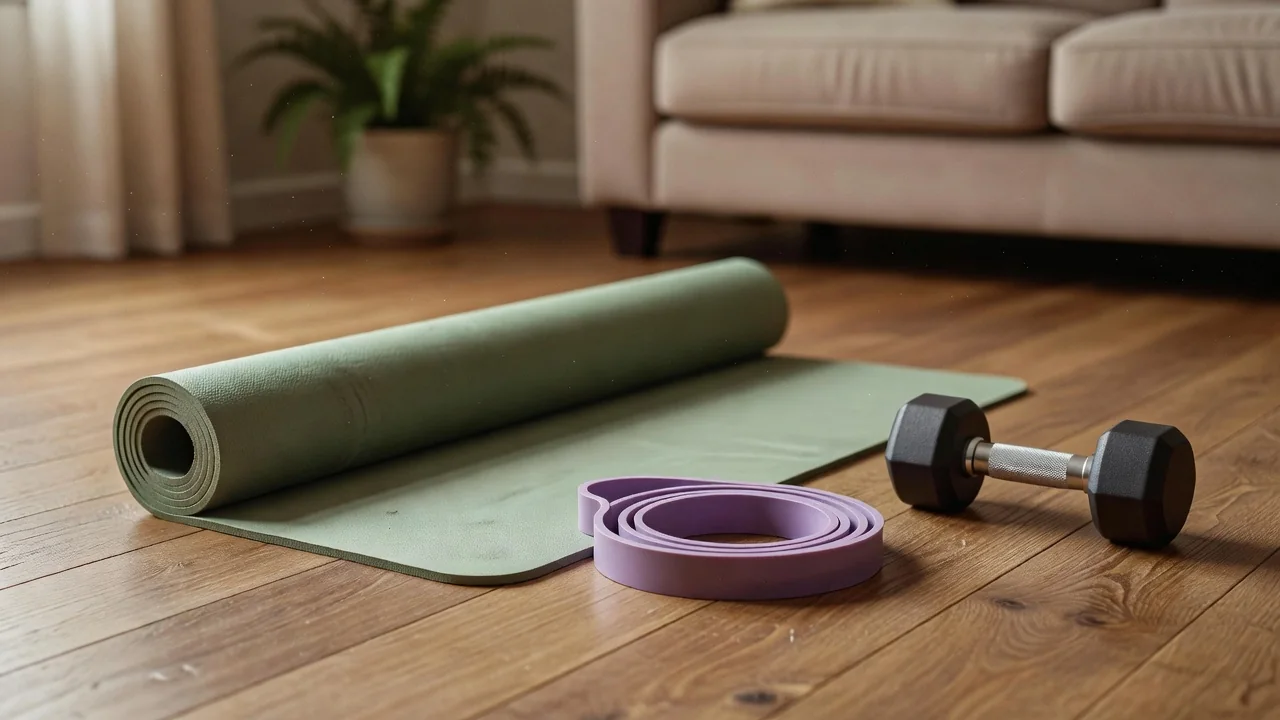
What can wait: kettlebells, benches, pull-up bars, and anything with a screen. None of them are useless, but every one of them is optional until the basic three have been used consistently for a few months. Buying advanced equipment before the habit exists is the most common way to build an expensive clothes rack.
What This Setup Can Honestly Train
With a mat, a band, and dumbbells you can load every fundamental movement pattern: squat, hinge, push, pull, and carry. Goblet squats and Romanian deadlifts cover the lower body. Floor presses and overhead presses cover pushing. Band rows and one-arm dumbbell rows cover pulling. Suitcase carries — simply walking with one heavy dumbbell — train grip and core better than most ab gadgets.
Cardio needs no equipment at all: brisk intervals on the spot, step-ups on a stair, or a skipping rope if your floor and neighbors allow it. Mobility work needs only the mat. The claim that home training cannot build real strength is true only at advanced levels; a beginner's muscles cannot tell the difference between a dumbbell and a machine.
Choosing Each Piece Without Regrets
A few practical checks separate equipment that lasts from equipment that annoys you within a week:
- The mat should not slide when you push against it with a wet palm, and should not curl at the edges after being stored rolled.
- Loop bands should list their resistance range; a set of light, medium, and heavy covers more ground than one band.
- Adjustable dumbbells should change weight in under a minute and lock with a clear click, not a vague hope.
- Grip texture matters more than looks: smooth chrome handles slip the moment hands sweat.
- Weight increments of about two kilograms per side are small enough for steady progress on presses and rows.
Costs and Trade-Offs at a Glance
Prices vary by region and brand, but the relative picture is stable: the full starter kit sits roughly at the level of one or two months of a mid-range gym membership, and it does not expire.
| Piece | What it trains | What it replaces | Buy or skip first |
|---|---|---|---|
| Exercise mat | Floor strength, mobility, core | Gym floor space | Buy first |
| Resistance band set | Pulling, shoulders, activation | Cable machine, lat pulldown | Buy first |
| Adjustable dumbbells | All pushing, hinging, squatting | Dumbbell rack, most machines | Buy first |
| Kettlebell | Swings, carries, conditioning | Nothing the dumbbells cannot do | Later |
| Pull-up bar | Vertical pulling, grip | Lat machine | Later, if a doorway allows |
| Weight bench | Press angles, step-ups | A sturdy chair for now | Later |
A Weekly Structure That Survives Real Life
The simplest durable plan is three full-body sessions per week with at least one rest day between them. Each session runs through one squat pattern, one hinge, one push, one pull, and one carry or core movement — three sets of eight to twelve controlled repetitions each, with the last two repetitions feeling honestly difficult.
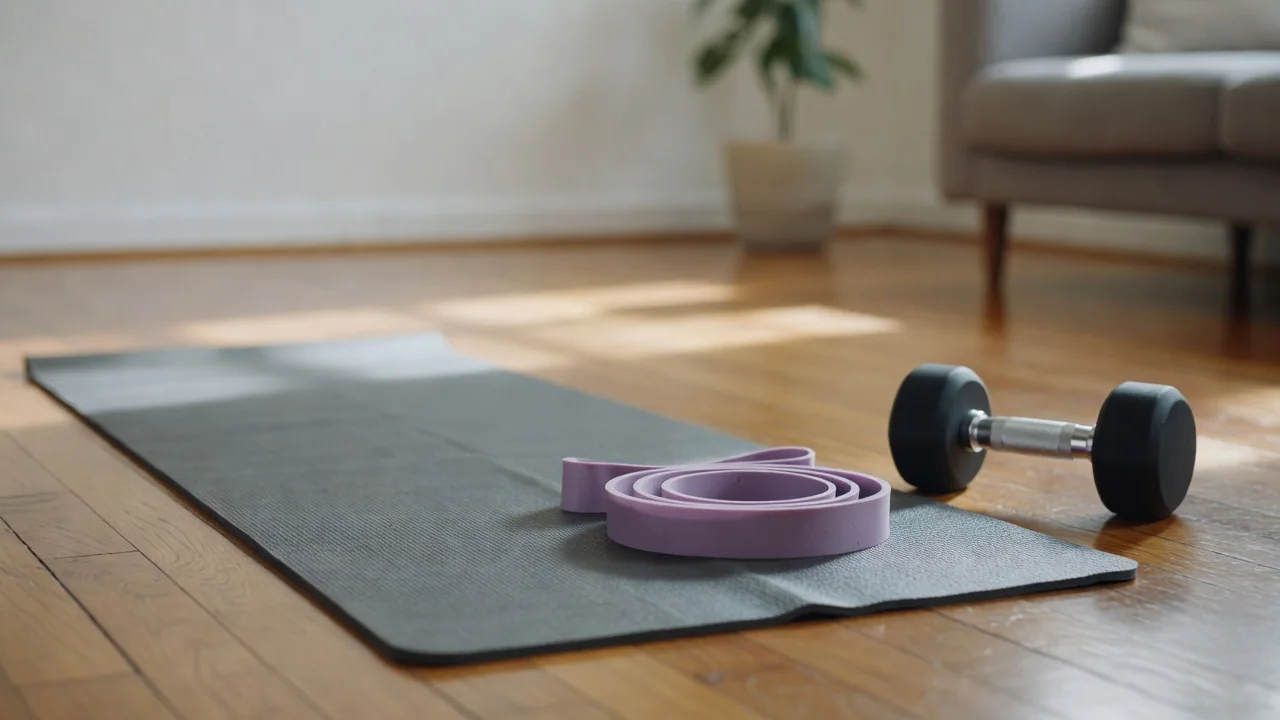
Short on time, two sessions still work; progress slows but does not stop. What breaks home training is not the equipment, it is the missing appointment with yourself — so put sessions in the calendar like meetings, and keep the gear visible rather than hidden in a closet.
How to Progress Without Heavier Machines
Progress at home comes from four levers: more repetitions, slower lowering, shorter rests, and more weight on the dial. When twelve controlled repetitions of a movement feel comfortable, turn one of those levers rather than shopping for new tools. Pausing at the hardest point of a squat or press makes a light weight behave like a heavy one.
Write the session down — exercises, sets, repetitions, and the weight used. A simple notebook turns guesswork into a trend line, and the trend line is what tells you when the dumbbells genuinely need to go heavier.
Mistakes That Make Home Equipment Feel Useless
Three errors account for most abandoned home setups. The first is buying everything at once: a room full of gear with no routine behind it. The second is training without progression — the same comfortable weight for months, which maintains but never builds. The third is skipping the warm-up because the gym is just the living room; cold muscles do not care about the address.
Start small, train on schedule, progress on paper. The minimal setup is not a compromise — for the first year of training it is simply the right tool.